Team
Yuhan ke, Benedicta Gokah, Max Kurchitskiy, Bhairavi Ruparel
Tools
Figma, Mural, and Google Suite
UX Designer and Researcher
Individual Contribution
August 2024 - December 2024
Duration
Client
United Airlines
A Moment of Clarity, Built into Every Scan
Intentional confirmation
Active engagement with passengers


4. Confirm New Group Pass

1. Edit Group Pass
.png)
2. Remove Person

3. Updated Boarding Pass


One Pass. Less Chaos. A Simpler Way to Move Together
Opt-In Setup
All in one place
Toggle Switch
Group Details
Simplifying group boarding starts with a unified, scannable pass, for both families and gate agents.
Group QR code

Identifiers for people in the group
Initial concept
Toggle Switch: Switch between TSA security mode and United Airlines group mode
Number of passengers associated with group code
Passenger seat numbers

Boarding Chaos Shifts Focus from People to Procedures, for Both Families and Frontline Staff
Group boarding often overwhelms both families and gate agents. Parents juggle kids and bags, while agents multitask, handling passengers, documents, and announcements. We mapped their boarding journeys to discover untapped opportunities and understand how we could create more seamless experiences for everyone.

-
Managing multiple luggages
-
Multiple boarding passes
-
Passengers feel stressed about delaying others in the boarding line
"We have no issue with the boarding process. The only challenge boarding with 3 children is the unspoken pressure of others in the line wanting you to hurry up."
Passengers

-
Frequent task switching
-
Duplicate scans
-
Manual Verification
-
There is constant time pressure to keep boarding on schedule
"I have to verify and match as you board, they will hand me boarding passes for John Doe while Jane Doe is boarding. We get duplicate scans like that all the time!"
Gate Agents

Group Boarding Isn’t Just a Problem, It’s a Missed Opportunity to Serve Millions of Travelers Better
Each year, millions of families and groups travel together, forming a major portion of United Airlines' customer base.
From January to August 2024 alone, United Airlines recorded over 20 million unique bookings, with 50% involving 2+ passengers, across both domestic (20%) and international (32%) routes
Through primary research and synthesis, we identified our target audience as...


Parents with young children
Adults traveling with an elderly companion (s)
Elder couples
United Airlines is exploring how to better support group travel as part of its broader effort to enhance the travel experience. The project focuses on reimagining the boarding process to better accommodate the needs of people traveling together, making the experience seamless, intuitive, and connected.
Changing the way groups board, to stay connected and stress-free

The Challenge
United Scan2Go
Using the Double Diamond framework, we moved from research and real-world observations to synthesis, ideation, and iteration, arriving at experience-focused solutions that reimagine how group travel is supported during boarding, with new opportunities for connection, clarity, and ease.
Our Solution

Passenger-Focused Solution
How might we improve the group boarding experience to better support both passengers and gate agents?
Identified Gap & Opportunity
Not every group boarding goes as planned, and that's okay. Managing real-life changes like cancellations or no-shows is now fast, flexible, and fully user-led.
Gate Agent-Focused Solution
Process
We conducted field observations at O'Hare International Airport with the United Airlines team, using the AEIOU framework to capture behaviors and friction points. Through contextual inquiry, we gained deeper insights into passenger and gate agent workflows.
5 Gates
83%
2:34 Mins
Observed complete gate
boarding process `
Passengers preferred digital passes over paper passes
Time taken by a family in boarding group 5 to transition from the waiting area to the jet bridge
Key Insights

Prior to boarding, passengers perform various rituals to ease the anxiety when flying

Errors are common, resulting from over-scanning or under-scanning boarding passes at the gate
Contextual inquiry conducted with a gate agent
From Digital Preference to Group Dynamics, Boarding Exposes Invisible Friction
There is unspoken social pressure experienced when boarding as a group
Two Critical Phases Shape the Entire Group Boarding Experience

Through field interviews and observations at O’Hare, we analyzed the boarding journey using two strategic lenses, United’s control over actions, and the Can Do / Should Do / Must Do framework.
This helped us identify two key phases with the highest potential for impact:
-
Pre-boarding preparation
-
Boarding pass verification
These moments offered the best opportunities to reduce stress, improve efficiency, and enhance the group boarding experience.

Team synthesis, mapping the observations using the can do/should do/must do framework

Recognizing Current Limitations, Revealing Future Possibilities
We tested the single-group boarding pass concept through a comprehensive 45-minute simulation involving 18 participants, complemented by usability testing. Our mock airport environment allowed us to directly compare the existing process (Test A) with our proposed solution (Test B), measuring effectiveness, passenger behavior patterns, and optimal group size.
Test A
Test B
Controlled test reflecting the current boarding process.
Solution test using the proposed single-group pass

The Classroom Simulation Setup

.png)
.png)
Class room simulation set up
Made Ideas Tangible, Fast
Quick iterations helped uncover blind spots, align with client expectations, and keep progress on track.
Concept 1


We started exploring toggle switch interaction here, testing various information hierarchies and content arrangements.
Pro: New feature consolidates both boarding passes in one convenient location
Con: Users need time to become familiar with the new functionality
Concept 2


For the agent-facing design, we needed them to clearly identify who they were scanning the boarding pass for, the number of people in the group, and be able to engage with passengers.
Pro: Aligns with immediate client priorities for operational improvement and requires minimal technical changes
Con: Adds manual check-off task for gate agents during boarding process
Concept 3
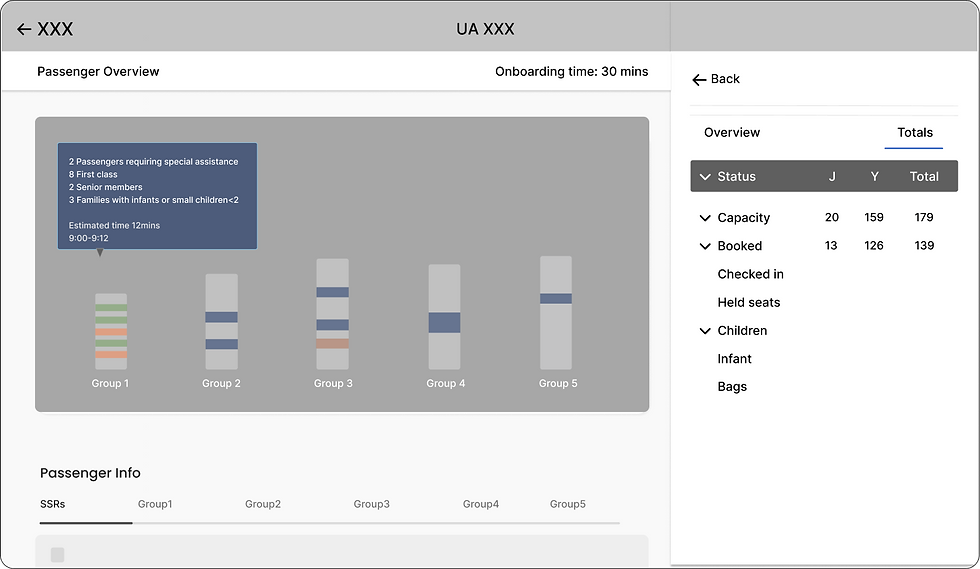.png)
Analyze and visualize all the possible slowness in the boarding process to better allocate staff for handling them
Pro: Valuable for long-term transformation
Con: Requires broader system changes and longer implementation timelines
We opted for Concepts 1 and 2 because their scanning mechanisms offer practical, implementable solutions that create a strong foundation for future development. Our high-fidelity prototypes maintained United Airlines' design language for consistency and incorporated WCAG accessibility standards to ensure inclusive experiences.
Key takeaways from simulation:
Operational Impact
It is possible to reduce the boarding time of a group by 46% through implementation of a single group boarding pass.
Fail-Safe Approach
A mechanism is needed to handle boarding for groups that are unexpectedly split due to no-shows or delayed arrivals.
Group Pass Limit
We hypothesize that boarding becomes less efficient when <5 people share a single PNR.
Usability Testing
Key takeaways:
“Toggle feature is efficient and makes sense to me."
Somehow make Pre-TSA and Post-TSA more clear, currently its not”
01
“ When it gets to the pop-up to opt in, that process isn’t so smooth. I didn’t know how to get there."
“Also opting in at the airport seems like an extra step especially when you are constantly bombarded at the airport.”
“Also If I opt in, do I get something from it?”
02
“The blue is overpowering the grey so a different color for toggle - highlight it.”
03
“I think the opting into group boarding should happen when people purchase their tickets rather than at the airport. To me that is the most advantageous point to introduce this features. Its always one more thing at the airport and I do not like that”
06
“I would have used this with my fiancé whilst traveling. We always juggle a lot of bags between us when boarding. With this feature, we can delegate who handles the bags and who boards us in”
05
“Its a nice to have for people traveling in groups, but its a necessity for families. I see the use case more for people with some level of familiarity with each other”
04
My Takeaways
This project involved rapid client debriefs, problem reframing, risk analysis, and prototyping, giving me insights into how design and research can support strategic airline operations.
-
Observing workflows highlighted the importance of agent-facing aspects. Integrating these into the design process taught me how research can uncover overlooked touchpoints that make solutions more holistic.
-
I learned to identify key pain points and analyze their broader impact, which sharpened my ability to reframe problems and focus on what truly matters for both users and the business.
-
Conducting rapid tests provided immediate feedback, helping me refine prototypes and see the solution from fresh user perspectives. This reinforced the value of frequent testing.
-
I gained experience aligning design decisions with business goals, security regulations, and user needs. This strengthened my ability to communicate across stakeholders and bridge research insights with organizational priorities.